The ankle cuff: the sign that ends most arguments
Tissue that stops dead above the ankle, with a normal foot underneath. It is the sign clinicians reach for first, and it is the easiest one to photograph.
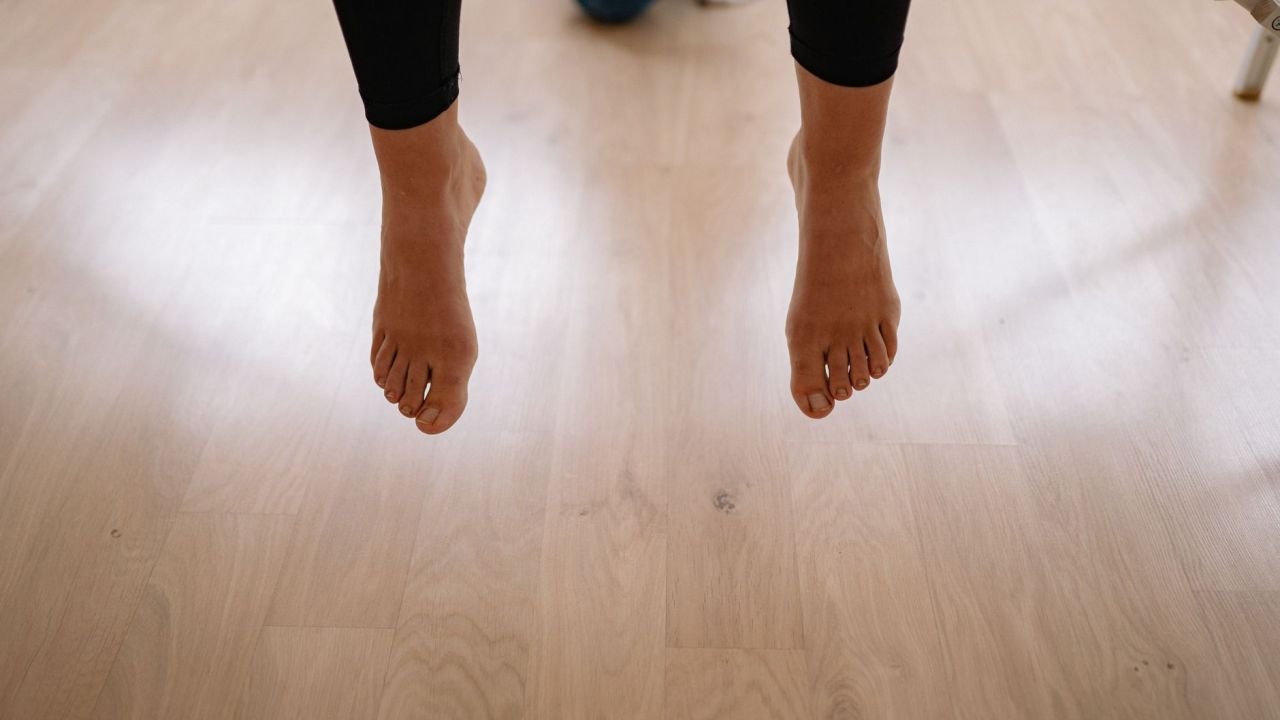
Photo: Yan Krukau / Pexels
In this article
If you look at your leg from the side and see something that looks like a bracelet — a fold or a ledge where the calf tissue ends and a comparatively ordinary foot begins — you have found the ankle cuff. In the literature it is sometimes called the cuff sign or the bracelet sign, and it is one of the features found in more than 80% of women with lipedema.
Why it happens
Lipedema affects fat tissue in a specific distribution, and that distribution ends at the ankle. The feet and hands are essentially spared — the tissue that expands simply is not present there in the same way. So the affected tissue builds up down the leg and then stops, and the abrupt transition is visible as an overhang above a normal-sized foot.
That is different from every kind of swelling caused by fluid, because fluid runs downhill. Anything driven by fluid — lymphoedema, heart failure, venous insufficiency, a drug side effect — pools in the lowest part of the limb, which is the foot. That is the whole reason the sign is worth so much diagnostically: it tells you what the problem is not.
What the cuff tells a clinician
- The problem is tissue, not free fluid.
- It is unlikely to be a systemic cause of swelling (heart, kidney, thyroid, medication) — those involve the feet.
- It is unlikely to be pure lymphoedema, which takes the foot and toes.
- Combined with symmetry, pain and easy bruising, it makes lipedema the leading explanation.
How to photograph it so it does the work
Half the value of this sign is lost because of how it gets photographed. Six things:
- Stand up. Sitting hides it.
- Both legs in frame, feet included. The comparison between ankle and foot is the entire point; a photo cropped at the ankle throws away the evidence.
- Bare feet, no socks, no trousers.
- Daylight, plain background. Bathroom lighting flattens everything.
- Two angles. Straight on from the front, and from the side. The side view shows the overhang best.
- Camera at ankle height for the close shot, not looking down from your own eye level.
Take them at the same time of day each time — legs change through the day — and keep them. A set of photos over months is far more persuasive than one, and it is exactly the kind of documentation an insurance case needs later. What else to bring to the appointment.
When the cuff is not there
Two situations, and they mean opposite things.
You have lipedema but the cuff is subtle. Common in early stage 1, in type 1 (hips and buttocks only) and in type 2 (down to the knee) — if the tissue never reaches the ankle, there is nothing to form a cuff. The absence of a cuff does not rule lipedema out; it just means this particular sign is not available to you and the others have to carry the case.
The cuff you used to have is fading. This one matters. If the ankle definition you could once see is blurring, and the foot is starting to look puffy, that can mean a lymphatic component has developed — lipo-lymphoedema. It is worth raising with a clinician rather than waiting, because that is the stage at which treatment intensity usually needs to step up. The two conditions and the overlap.
Quick check you can do right now. Try to pinch and lift the skin on the top of your second toe. If it lifts easily, that is a negative Stemmer's sign and points away from lymphoedema. If you cannot lift it, mention that specifically at your next appointment.
One thing the cuff does not tell you
It says nothing about severity or about how much pain you are in. It is a distribution sign — it tells you where the tissue is, not how much trouble it is causing. Women with a textbook cuff and mild symptoms exist, and so do women in significant pain whose cuff is barely visible. Stages, types, and why neither predicts pain.
If you are building a case for a doctor who has not taken you seriously so far, the cuff photograph plus a written list of the other features is the strongest thing you can walk in with. What to say if you are dismissed anyway.
Questions people ask about this
What is the ankle cuff in lipedema?
It is the visible ledge or bracelet where lipedema tissue stops abruptly above the ankle, with a comparatively normal foot below it. It happens because lipedema affects fat tissue in a distribution that ends at the ankle, unlike fluid-driven swelling, which pools in the lowest part of the limb and therefore always involves the foot. It is present in more than 80% of women with lipedema and is one of the most useful things to photograph before an appointment.
Can you have lipedema without an ankle cuff?
Yes. If the affected tissue does not reach the ankle — type 1, which is hips and buttocks only, or type 2, which stops at the knee — there is nothing to form a cuff. It can also be subtle in early stage 1. Its absence does not rule lipedema out; it means the other features have to carry the diagnosis.
What does it mean if my ankle cuff is disappearing?
If the ankle definition you used to have is blurring and the foot is starting to look puffy, that can indicate a lymphatic component developing on top of the lipedema — lipo-lymphoedema. It is worth raising with a clinician rather than waiting, because treatment intensity usually needs to increase at that point.
Start where you are
You do not need a diagnosis, a plan, or a good week. You need somewhere to put the information so that in three months you can see what actually changed.
Create a free account